The Blue Book of Nebo and The Blackthorn Branch

The Blue Book of Nebo by Manon Steffan Ros and The Blackthorn Branch by Elen Caldecott

Books of the Week: 26 February 2003

Cover design by Becca Moor

Cover illustration by Rachael Dean

It has been a long time since I’ve picked a book of the week, so I decided to read two books from the recently-announced longlist for the Yoto Carnegies. To remind me of my homeland, I chose two stories set in Wales, both of which highlight the importance of stories and reading and the power of the natural world.

The Blackthorn Branch is a middle-grade fantasy and The Blue Book of Nebo is a post-apocalyptic novel aimed at older readers.

The Blue Book of Nebo

Fourteen-year-old Dylan, his baby sister Mona and his mum Rowenna live near the village of Nebo in ‘the middle of nowhere’. From their house they can see the towers of Caernarfon Castle, the sea and the island of Anglesey. One day, when Dylan is six, Rowenna hears a radio announcement at work saying that bombs have been dropped on big American cities. She drives to the nearest large town, where she loads up a hired transit van with supplies and returns home. A couple of days later, the power goes off and the frightening chain of events that Dylan and Rowenna call ‘The End’ changes the world forever. The two decide they will write their experiences in a blue notebook that they scavenge from the local village. Rowenna will write about ‘olden days’ and Dylan about what their lives look like now. They promise not to read one another’s entries.

This ‘blue book’ makes for a brief, powerful and bleak read, but never a hopeless one. Despite the harsh conditions, Dylan and Rowenna find much more of a connection with the natural world. Dylan discovers a gift for growing food and a sensitivity to nature. Rowenna sees human emotions in the environment where a ‘potato field is kind on a warm spring day’ or the house develops a hole in the roof because it is ‘fed up’. They gain strength from books and reading, especially from exploring Welsh literature. Dylan notices that the books he used to read, that took cars and computers and phones for granted, don’t make as much sense as they used to and he turns to reading much older stories, including those in the Bible. This is a thoughtful and reflective read with themes that resonate long after the book has been put down.

A couple of good companion reads to The Blue Book of Nebo would be Z for Zachariah or Island of the Blue Dolphins.

The Blackthorn Branch

In the small village of Penyfro in North Wales, Cassie and her cousin Siân are trying to cast a spell using ‘a mush of leaves and rabbit poo and bottle tops’ stirred in a plastic bucket. Siân is confident it will work, but Cassie isn’t convinced that any spell will be able to transform her grumpy, teenage brother Byron back into someone who was fun to be with, rather than a giant sulker who doesn’t seem to care about her, or their Mam and Dad, any more.

One Saturday, when Byron has stormed off in yet another huff, the two girls follow him up the hill outside the village to the old railway line; a quiet, overgrown place since the decline of local industry. They spy on Byron from behind some bushes as he and three other teenage boys dance around a fire in front of a rusting car wreck. Cassie and Siân don’t recognise the boys and, when a flash of blue light erupts from the tunnel, they are so unnerved that they run back home.

The following morning they learn that Byron didn’t come home that night. When he fails to turn up as the day wears on everyone becomes anxious and afraid and a search is mounted. Cassie and Siân feel that the searchers are looking in the wrong locations. They know there is only one place they must venture in order to find him: the dark and dripping tunnel with its weird blue light where he disappeared.

This fast-moving read is an engaging mix of the magical and the everyday. The fantasy is rooted in Welsh myths and legends involving the type of fairy folk (tylwyth teg) who are given to deception, trickery and malice. In contrast, Cassie and Siân, their parents, their Nain (Welsh for ‘grandmother’) and the community of Penyfro are portrayed with warmth and understanding. Woven throughout are lyrical descriptions of the natural world and some messages about the value of stories and reading and the importance of nature. It all adds up to a charming and satisfying read.

The Blackthorn Branch is suitable for readers in Year groups 3-7, but can be enjoyed by anyone. If you are older than this, and like stories based on mythology and faerie, try the much more frightening ‘The Call’ by Peadar O’Guilin or ‘The Cruel Prince’ by Holly Black.

The Dark is Rising AND A Child’s Christmas in Wales

Quote

The Dark is Rising by Susan Cooper and A Child’s Christmas in Wales by Dylan Thomas

Books of the Week: 13 December 2020

Illustration by Joe McLaren

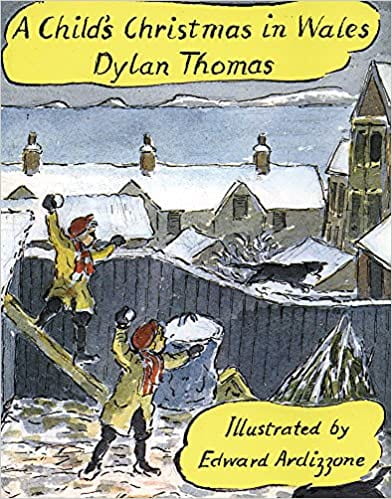
Illustration by Edward Ardizzone

In a wintry Buckinghamshire village, Will Stanton is waiting impatiently for his birthday the next day. Christmas is not far off and he is hoping for a crisp covering of snow. When he and his brother visit a nearby farm to fetch hay for their rabbits, they notice a throng of unusually noisy rooks that appear to be as spooked as the boys’ pet rabbits were when they fed them earlier. In addition to an encounter with a strange homeless-man, these signs make Will feel uneasy and threatened. When he shares this with Mr Dawson, the farmer, he is told ‘The Walker is abroad … And this night will be bad, and tomorrow will be beyond imagining.’ If you suspect that this means we are in for a tale of the magical and fantastical, you would be right. Will discovers he is no ordinary eleven year old, but one of the the Old Ones who must bear the burden of fighting the powers of Darkness throughout history.

This is the second book in The Dark is Rising sequence and I have chosen it because it is a landmark in fantasy writing for young people, because it is set at Christmas and because it is a wonderfully atmospheric read. Susan Cooper conjures a landscape that is drenched in history and the power of myth and folk magic, with a force of darkness that controls the natural world and threatens harm to ordinary people. Will may have his powers, but he feels isolated from his family and everyday life by his newfound knowledge. The whole story keeps us in a state of persistent dread. Although the first book in the sequence is Over Sea, Under Stone, it won’t spoil the experience if you read The Dark is Rising first and then go back to that one. The others are Greenwich, The Grey King and Silver on the Tree. In some of these the action moves to Wales, the setting of my next choice.

A Child’s Christmas in Wales is more a very short story than a book, but reminds me of growing up in Wales. I’ve chosen it for the humour and rich language. Who could resist rolling descriptions such as this:

Years and years and years ago, when I was a boy, when there were wolves in Wales, and birds the colour of red-flannel petticoats whisked past the harp-shaped hills, when we sang and wallowed all night and day in caves that smelt like Sunday afternoons in damp front farmhouse parlours and we chased, with the jawbones of deacons, the English and the bears, before the motor-car, before the wheel, before the duchess-faced horse, when we rode the daft and happy hills barebacked, it snowed and it snowed.

These are my final book choices as the Librarian of King Edward VI School because I will be retiring at Christmas after thirteen years in the job. It has been a privilege and pleasure to share books and reading with so many wonderful students and colleagues over the years. This blog will still be here to search for recommendations, but will of course no longer have an association with the School and the pictures and logo will all have changed by the end of this week.

The Short Knife

The Short Knife by Elen Caldecott

Book of the Week: 1 November 2020

Illustration by Miko Maciaszek

In this week’s book, we find ourselves in a Britain of darkness and confusion. The Romans left some years before and the invading Saxons are an ever-present danger, as Mai and her family are about to discover. When a visitation from Saxon strangers to their family farm results in Mai, her father and her sister, Haf, seeking sanctuary with Gwrtheyrn and his band of Britons in the Welsh hills, a tense, terrible and tragic series of events is set in motion.

This is a book where you can feel the hunger, smell the rot and wonder at the toughness and bravery of Mai who must try to survive in a brutal and alien environment. Expect plenty of tension and action expressed in some wonderfully lyrical writing.

If you enjoy historical adventures by writers like Rosemary Sutcliffe, or Joe Abercrombie’s Half a King then this is a must-read.

This is the 300th Book of the Week, which I started in January 2012 with This Dark Endeavour by Kenneth Oppel. For the first few years, the books were just displayed in the Library, until November 2014 when I started writing online reviews. In January 2015 the blog moved to this platform with the first choice being I Predict a Riot by Catherine Bruton. As much as I love judging book covers for their design (and I do always try to credit designers for their work) you can’t judge the contents of a book by its cover, as the old saying goes, which is why I started writing about the contents. We all need to find out a bit about a book’s plot before we decide to read it it – hence this blog and accompanying links on Twitter. If anyone has discovered a good read via this blog, then I’m happy. Endless thanks go to all the wonderful authors who write for young people and the often lovely acknowledgements they provide on social media.

Miss Peregrine’s Home for Peculiar Children

Miss Peregrine’s Home for Peculiar Children by Ransom Riggs

Book of the Week: 22 May 2016

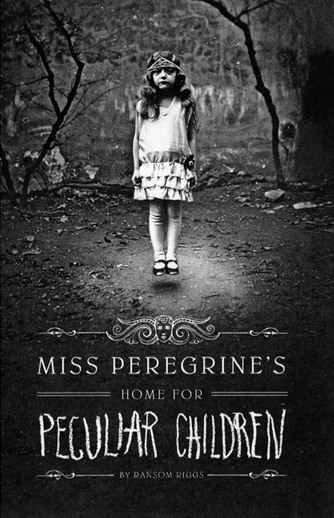
Miss Peregrine

A peculiar book about peculiar children that has caught the attention of director Tim Burton who is bringing out a film version in September.

Jacob’s grandfather has always been full of outlandish stories about his life in a Welsh children’s home when he was a boy. He has a collection of eerie photographs, such as the one on the book cover which appears to show a hovering girl, which Jacob dismisses as fakes. When his grandfather is found dead, Jacob and his father travel to Wales to search for the ruins of the children’s home and find out more about the life of Grandpa Portman. What Jacob finds when he gets there involves mystery, time-travel and a huge amount of peculiarity.

The feature that marks this book as out-of-the-ordinary is that the author has used vintage photographs, that are atmospheric and sometimes downright disturbing, to prompt his story. Despite the fairytale aspect, the style of writing feels more suitable for older readers. The central character is sixteen and it contains an element of romance.


Using old photographs is not unique to this series (this is the first part of a trilogy). There is a book for adults, now sadly out of print, published in the 1930s called Lady Addle Remembers where the author Mary Dunn used Victorian photographs to great comic effect to parody the aristocracy.